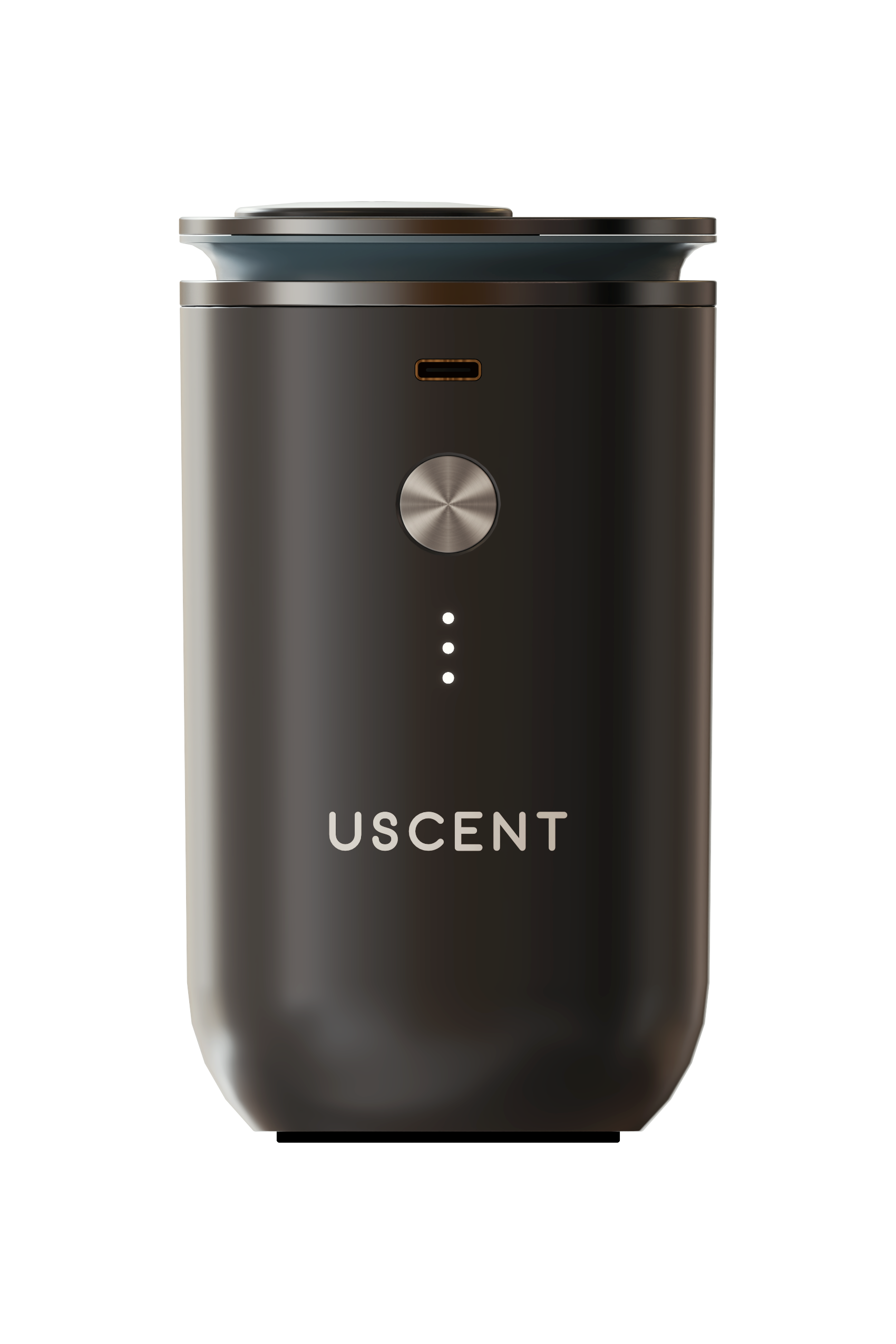
TL;DR: USCENT nebulizers use the venturi effect — a principle of fluid dynamics — to accelerate pressurised air through a narrow glass tip, creating a low-pressure zone that draws pure essential oil upward and shatters it into 1–3 micron dry particles. No heat. No water. No dilution. Just physics.
What Is the Venturi Effect?
The venturi effect is a principle of fluid dynamics first described by Italian physicist Giovanni Battista Venturi in 1797. It states that when a fluid (including air) is forced through a constricted passage, its velocity increases and its pressure drops. This pressure differential creates suction at the constriction point.
In a nebulizer, this means: a micro-pump pushes air at high velocity through a narrow glass or ceramic tube. At the narrowest point, pressure drops below atmospheric. The low-pressure zone draws essential oil upward from the reservoir below. The moment oil contacts the high-velocity airstream, it is torn apart into ultra-fine droplets — a process called pneumatic atomisation.
| Physics Concept | In the Nebulizer |
|---|---|
| High-velocity airstream | Micro-pump at 1.5–2.0 L/min flow rate |
| Constriction point | Glass capillary tip (0.3–0.5 mm internal diameter) |
| Pressure drop (Bernoulli) | Creates suction that lifts oil from reservoir |
| Pneumatic atomisation | Oil shattered into 1–3 micron dry particles |
| Output | Invisible dry micro-mist — 100% pure oil |
Why Particle Size Matters for Aromatherapy
Particle size is the most important — and most overlooked — factor in essential oil delivery. The human olfactory epithelium, located approximately 7 cm inside the nasal cavity, contains roughly 6 million smell receptor neurons. To reach these receptors efficiently, inhaled particles must be small enough to navigate the nasal airway without depositing on the outer mucosa.
Research published in Molecules (2021) on essential oil inhalation bioavailability demonstrates that particles in the 1–3 micron range (Mass Median Aerodynamic Diameter — MMAD) achieve the highest olfactory deposition efficiency, with therapeutic compound onset within 30 seconds of inhalation.
By contrast, ultrasonic diffusers produce particles averaging 5–10 microns — larger, heavier, and heavily water-diluted. They deposit primarily on the inner nostrils rather than reaching the olfactory epithelium. The result is a weaker, less therapeutic experience at significantly higher oil consumption.
How USCENT's Glass Nebulizer Tip Works
The heart of every USCENT device is a borosilicate glass nebulizer tip — a hand-blown precision component with an internal capillary diameter between 0.3 and 0.5 mm. Borosilicate glass is used (rather than plastic or metal) for three reasons:
- Chemical inertness: Essential oils are chemically aggressive solvents. Plastic components leach BPA and phthalates into the oil stream within weeks. Borosilicate glass is completely inert to all essential oil compounds.
- Dimensional stability: The capillary diameter must remain precise to maintain consistent particle size output. Glass does not swell or deform with oil exposure, temperature change, or cleaning.
- Cleanability: Borosilicate glass can be rinsed with isopropyl alcohol to clear oil residue without degrading the tip geometry.
Cold-Air vs Heat-Based Atomisation: Terpene Preservation
Essential oils are complex mixtures of volatile organic compounds — primarily monoterpenes, sesquiterpenes, and oxygenated derivatives (alcohols, esters, oxides). The therapeutic properties attributed to lavender, eucalyptus, rosemary, and other oils derive from these specific compounds.
Most terpenes begin to degrade at temperatures above 40–50°C. In a heat-based diffuser or candle warmer, the oil reaches 60–80°C — well above the degradation threshold for linalool (lavender's primary active compound), 1,8-cineole (eucalyptus/rosemary), and limonene (citrus oils). The result is chemically altered oil with reduced therapeutic activity.
Cold-air nebulization operates entirely at ambient temperature. The venturi effect requires only airflow — zero heat input. The terpene profile of the oil entering the device is identical to the terpene profile reaching your nose. This is why aromatherapy practitioners consistently prefer nebulization over any heat-based delivery method.
The Auto-Interval Mode: Engineering for Scent Fatigue Prevention
USCENT nebulizers include an auto-interval mode that cycles 30 seconds on and 60 seconds off. This is not an arbitrary timer — it is engineered around the olfactory adaptation curve.
The human nose adapts to a constant scent stimulus in approximately 2–3 minutes, a phenomenon called olfactory adaptation (colloquially "nose-blindness"). By pulsing output in short bursts with rest intervals, the interval mode prevents receptor saturation, maintaining perceptible scent intensity throughout the session at roughly 40% of the oil consumption of continuous-output devices.
Frequently Asked Questions
Is venturi-effect nebulization the same as ultrasonic diffusion?
No. Ultrasonic diffusers use a ceramic disc vibrating at 2.4 MHz to agitate water and oil into steam. Venturi nebulizers use pressurised cold air — no vibration, no water, no heat. The output particle size, oil concentration, and mechanism of atomisation are fundamentally different.
Does cold-air nebulization work with thick oils like sandalwood?
Thick oils with high viscosity can clog glass capillary tips. Dilute oils denser than jojoba (approximately 0.91 g/cm³) with fractionated coconut oil at a 4:1 ratio before use. USCENT scent capsules are pre-formulated to the correct viscosity range.
How often should I clean the glass nebulizer tip?
Every 2–3 oil capsule changes, or whenever output volume noticeably decreases. Remove the glass tip, soak in isopropyl alcohol (70%+) for 10 minutes, rinse with warm water, and air-dry completely before reassembling.
Experience the Technology
Explore the full USCENT range at uscent.life. Every device ships with one starter scent capsule. Free shipping over $79 AUD. Afterpay available across all Australian states.
Sources: Venturi G., Recherches expérimentales (1797); Molecules (2021) — Inhalation Bioavailability of Essential Oils; Buchbauer G., "Biological activities of essential oils," Handbook of Essential Oils (2020); Bernoulli D., Hydrodynamica (1738).